I gotta say, reading about Dolores Umbridge inspires a LOT of #7
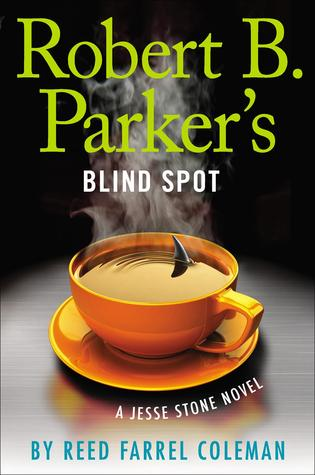
WHAT have you finished reading recently? Robert Parker’s Blind Spot. Meh.
WHAT are you reading now? I’m listening to the full cast audio of Harry Potter and the Order of the Phoenix, and reading Eleanor Oiliphant is Completely Fine along with Treacherous Alliance for my serious read. The latter is a history of Israeli, Iranian, and American relations.
WHAT are you reading now? I need to start Paradise Lost by Milton.
1-4: Harry Potter and the Full Cast Audio Editions. These are wonderful.
5. Fan Fiction, Brent Spiner and the cast of Star Trek TNG. Fan Fiction is a silly novel ‘inspired’ by Brent Spiner’s experiences with overzealous fans, but the audiobook version of this actually brings in his TNG castmates to voice their past selves, and it’s brilliant. Reading the book when you can hear Patrick Stewart and Martina Sirtis is a travesty.
6. “A Christmas Carol” read by Sir Patrick Stewart. He even makes Christmas bell noises.
7. Woke Up this Morning, Michael Imperioli & Steve Schrippa. An oral history of The Sopranoes. Oh!
8. The Glory of their Times, Paul Ritter. Interviews with guys who played baseball professionally in the 1920s and 1930s.
9. Cold as Hell. Roger Clark, the mocap and voice actor for Arthur Morgan in RDR2, here does the voice artisty for a cowboy who died too nasty to go to heaven but too good to go to the other place. So, he’s given a black badge and told to rid the earth of nasty nephilim like vampires. Fun dark western fantasy.
10. Anything Wil Wheaton does, but especially Redshirts, Masters of Doom, and Ready Player One.
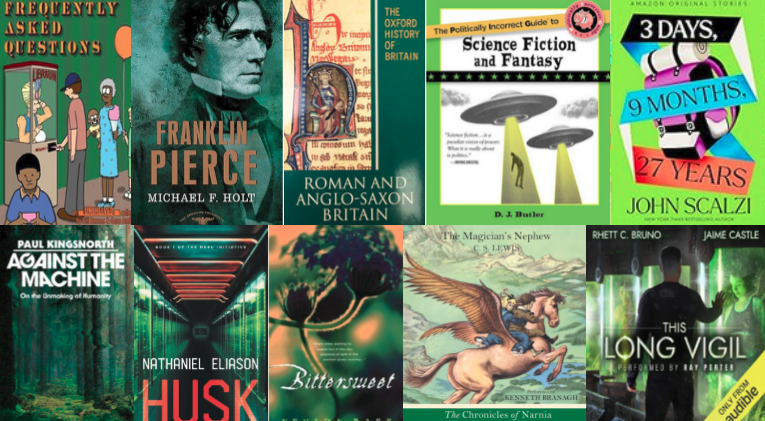
Today’s treble T is books with green book covers, in honor of St. Patrick, whose feast day is today. He is the patron saint of Ireland and green rivers. Funny story: blue was originally the color associated with St. Patrick, not green. So, if someone goes pinchin’ ya while wearing azure blue, you can give them a lecture. Cover-oriented lists are the worst, Patrick, because I don’t really remember books by their cover: I don’t judge them by that, ya see? I’m just going to have to trawl my posts looking for greenery..
Teaser Tuesday
Even alcoholics deserve help, I suppose, though they should get drunk at home like I do so that they don’t cause anyone else any trouble. But then, not everyone is as sensible and considerate as me. – ELEANOR OILIPHANT IS COMPLETELY FINE
(2) Franklin Pierce, a short biography American president Franklin Pierce.
(3) Roman and Anglo-Saxon Britain. There’s a bit of irony for you to celebrate St. Patrick’s day. Not one I’ve read, merely one I own.
(4) The Politically Incorrect Guide to Science Fiction and Fantasy, which is a decidedly odd volume in the PIG series: there’s almost no politics, just the author talking about his favorite SF&F titles and ruminating on modern trends he doesn’t like, like “hard” magic with rules.
(5) “3 Days, 9 Months, 27 Years“. A short story by John Scalzi about a time machine that only allows return after the aforementioned intervals.
Robert Parker’s Blind Spot is a mystery/thriller novel written to continue the stories of one of Parker’s existing characters, Sheriff Jesse Stone. I ran across the novel because I was looking for novels with baseball connections: this one begins when Stone is invited to a reunion of the minor league ball club he used to play before, before a fielding mishap wrecked his shoulder and cut short his career in professional ball before it really began. While Stone is at the party being seduced by his ex-girlfriend’s friend (said ex-girlfriend is there because she’s married to his former teammate), a teenage girl is murdered and her bedmate abducted. Random! Or…not. It turns out that Stone’s teammate had gotten into some shady business and wanted Jesse to help bail him out. Beyond the baseball intrigue – did teammate mean for Stone to get injured and put him out of the game? – I was largely uninterested in the plot, especially considering how many bedroom scenes there are. I can see returning to the Spenser series just because the Chandler influence was so strong, but this book didn’t do anything for me besides make me eye other books with longing.
I’m currently halfway through Harry Potter and the Order of the Phoenix, full-cast audio edition, and beginning Eleanor Oiliphant is Completely Fine.
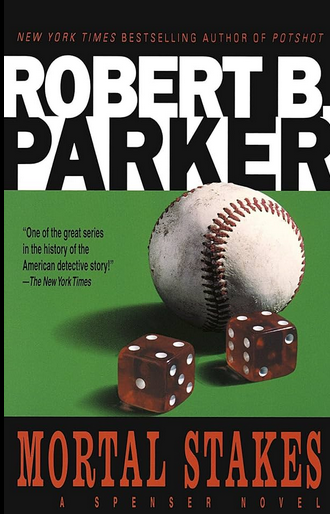
Spenser is a private detective working in the Hub City, and he’s just been approached with an interesting job. Red Sox management thinks one of their players is throwing games, and they want him to find out if their hunch is right, and if so, who the ne’er do well is. Posing as an author who is writing a book about the Red Sox, Spenser begins hanging out, getting to know the players and enjoying matches against the Yankees from a primo box. When he catches wind of a clue, it will take him into dangerous territory, involving both gangsters and crooked men attached to professional baseball. This was my first dip into the Spenser verse, and I found Parker’s attempt to resurrect Philip Marlow absolutely charming — from the terse narration to the frequency of violence and the heavy presence of whiskey. I was already predisposed to like this, given the Red Sox connection, but the tapping into Chandler’s style was so effective I could hear Bogie as Marlowe, and I sunk into the story for the pleasure of its narration if nothing else. It turns out a ball player’s wife has a…..past, you might say, and there are a couple of men giving the player the business: he has to throw games or else they’ll expose her. Spenser is able to find another option. I’ll definitely be reading more Spenser, he’s a gas. Parker captures Chandler’s style so well I could hear Bogie-as-Marlowe reading the entire book to me.
Ah, wilderness. The only flaw was that the gun on my right hip kept digging into my back.
“He’d made an error coming to see me, but it was the kind of error guys like Doerr tend to make. They get so used to having everyone say yes to them that they forget about the chance someone will say no.”
“Is his part of your technique, Spenser? Candlelight and wine and perhaps I’ll remember something about the young lady?” “Well, there’s that. But I hate to eat alone. The only people I know in the City are you and Violet, and Violet already had a date.” “Well, I don’t know how I feel about being second choice to — what was it you said — an East Village Pimp?”
“You spend too much time reading, Spenser. You know more stuff that don’t make you money than anyone I know.”
“I think you’re supposed to value me first,” she said, “then the food basket. I’ve always been suspicious of your value system.” “You look good enough to eat.” “I think I won’t pursue that line.”
“This is a thirty-eight caliber Colt detective special. If I pull this trigger, your mastery of the martial arts will be very little use to you.”
“Marty, you are the third person this morning who has offered to disassemble my body. You are also third in order of probable success.”
That’s the thing about a shotgun. At close range you don’t have to go checking pulses afterwards.
“There is a knife blade in the grass,” I said, “and a tiger lies just outside the fire.” “My God, Spenser, that’s bathetic. Either tell me about what hurts or don’t. But for God’s sake don’t sit here and quote bad verse at me.” “Oh, damn,” I said. “I was just about to swing into Hamlet.” “You do and I’ll call the cops.”
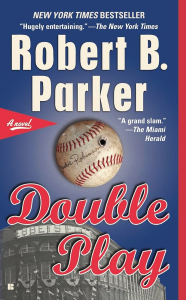
WHAT have you finished reading recently? Double Play, Robert Parker.
WHAT are you reading now? Mortal Stakes, Robert Parker — and Harry Potter and the Order of the Phoenix, full-cast audio edition. Released yesterday but I had a night class, so I’ve only gotten to when the Order of the Phoenix busts Harry out of Dursley Prison so far. Enjoying the vocal artist for Tonks.
WHAT are you reading next? Robert Parker’s Blind Spot, Reed Coleman. A continuation of one of his characters’ series. (I’m reading it for the baseball connection.) And Paradise Lost…..
Burke has returned home from World War 2 with a body full of scars and a mind even more disturbed. He arrived home not to hugs and kisses, but to a letter from his wife telling him that she’d run off with another man. Considering how torrid and fast his own courtship is with her, that wasn’t much of a surprise. Once fully healed — physically, anyway — Burke finds work for himself as a tough guy of sorts, working as a bodyguard. He’s hired by Branch Rickey, general manager of the Brooklyn Dodgers, with a special client: Jackie Robinson. The former Monarch is being brought into the Major Leagues, breaking the ‘color line’ that has kept baseball segregated. Ricky anticipates trouble: that’s why he chose Robinson, a man who was not only talented but who can keep his head, and it’s why he wants someone watching Robinson. Robinson needs protection from those who might try to assault him, yes, but he also needs someone to hold him back if provocations make him lose his cool.
This is the set up of Double Play, a novel that is more baseball adjacent than about baseball. Burke doesn’t care whether he lives or dies, and in the course of his work he angers or shoots dead several mooks who are in the pay of New York’s criminal elements. Burke’s lack of fear, tolerance of pain, and skills with his Colt 1911 come in handy a few times, and his relationship with Robinson is interesting. Because this is 1947 and segregation is as much a thing de jure if not de facto in New York, the pair find themselves struggling together: cabbies of either color ignore them out of fear, and when Burke accompanies Robinson in black restaurants and the like he’s glared at with contempt and hatred. There are at least two sets of baddies to deal with, and one possible femme fatale. This was a fast, punchy novel: while there’s not as much content on baseball or Jackie as one might expect, the game is never far away. There were some odd chapters following a young man named “Bobby” who grew up watching Jackie, and readers all appear to believe that these are the author (Robert/Bobby) being autobiographical and sharing the story of how he was inspired as as a kid. Some scenes were ‘racier’ than I’d like, no pun intended: Parker didn’t fade to black as quickly in the bedroom scenes as I’d personally prefer. The setup was fascinating, though, and the writing drew me in immediately. I’ve already gotten two more Parker & baseball novels checked out.
Today’s TTT is “books with ordinal numbers in the title”. Mmkay…..
But first, a tease from Robert Parker’s Double Play:
“We need to work this out,” Burke said. “I don’t want to have to keep shooting people.” “We got plenty.”
(1)One No, Many Yeses, Paul Kingsnorth. On global resistance to corpo-homogenity in favor of local economies. Oh, wait, “One” isn’t ordinal, it’s cardinal…
(2) The Last Man in Europe, Dennis Glover. If first is ordinal then by gosh and by golly last oughta be ordinal.
(3) The Eighth Continent, Rhett C. Bruno and Felix Savage. Hard SF on the moon. A bonafide ordinal!
I lived in lies all my life And I’ve been living here for a long, long time And I know its been coming down a while now… (Deer Tick, “Art Isn’t Real”. Original opening song to the KC.)
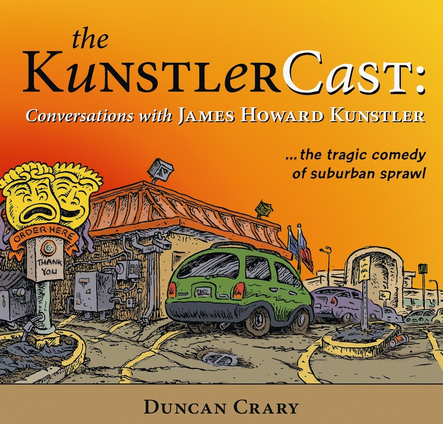
Almost twenty years ago I attended a guest lecture at my university and heard a talk that would prove to be exceptionally influential on my thinking. The talk, by Jim Kunstler, was on how American urban design – the built environment – had become not only ugly and injurious to human happiness, but fundamentally unsustainable. This was an iteration of a talk he’d been giving for a few years, but for the audience that night – who were going home to more dire reports of banks and businesses closing and jobs being lost and a global economy in peril – his diagnosis was particularly dire. He gave me a lot of food for thought; a vocabulary to articulate things about traditional city design versus modern city design; and an interest in energy, housing, and transportation policies that would fundamentally alter my politics and indeed my entire political orientation. Back then, Kunstler was in the middle of a sequence of books with a common theme – essentially, the imminent consequences of our refusal to live within limits, our conviction that the cheap oil era would last forever, and our faith that technology would always save us from said consequences – and as part of his profile, he had a podcast called the KunstlerCast. It’s changed much over the years – these days Kunstler interviews other people, but back then a young journalist was interviewing him about various topics that fell within this wheelhouse. The young journalist, Duncan Crary, turned the early years of the podcast into a book, which i devoured. Recently while looking for a break from St. Augustine, I saw the fun cover of this one on my shelf and decided to revisit it. I have reviewed the book before, so this review will incorporate reflections on what’s changed in 15+ years or so. If you want my original take, head here.
Because of its source, The KunstlerCast is a more varied book than Kunstler’s solo works. Each of those was written with a particular topic in mind, and as I commented in my review of his last nonfiction work, they were a bit like railroad cars: each book connected to the other but all were part of the same train of thought. These interviews reflect that train of thought, but they also have more miscellaneous content that allows Kunstler to broadcast his inner curmudgeon. Kunstler identifies himself as a jovial, upbeat guy, but one who despises the triviality and superficiality of late-2000s American culture. The first half of the transcripts here include discussions on topics within the Geography of Nowheretrainshed: the origins of suburban sprawl, the cheap and performative nature of the buildings and architecture associated with it, and on. If you’ve never encountered Kunstler before, here’s an elevator speech: he is a strong critic of postwar American urbanism who believes that the ugliness of early industrial cities created a hyper-reaction of people not only fleeing the cities, but adopting zoning and building methods that would ensure that those escaping to suburbia would never live anywhere near factories again. This new approach at the built environment reduced all human urbanism to three general categories (Residential, Commercial, and Industrial) and then made pains to separate them far from each other: as a result, urbanism became profoundly car-oriented, and fundamentally anti-human. This anti-humanness is expressed not only by the fact that it reduces everyone to being reliant on cars to do anything, but because it destroys the public realm completely, creating a nation of consumers who get and spend and then go home to watch advertisements for buying more stuff while surrounded by plastic crap they don’t need. To this add Kunstler’s later criticisms that all this is unsustainable because the cheap oil age won’t last forever, and that no, energy-intensive tech is not going to solve the problem because it itself is dependent on cheap energy.
Within Kunstler’s original argument in Geography of Nowhere there were elements that might seem like digressions, but which to Kunstler are still key parts. He often objects to things on aesthetic grounds, like the fake shutters applied to suburban homes that he reviews as cartoony imitations of actual country homes in themselves. The digressions show up more here, because Crary and Kunstler’s conversations are far more informal than a lecture hall. Thus we get remarks on how cartoony Americans themselves are becoming — obese ‘land whales’ shuffling around, dressed like kids who have no respect for themselves because they grew up in a culture that does not take anything seriously, from the built environment to sober evaluation of our future issues. Kunstler can easily come off as a grouch to those who aren’t familiar with him as a person or who don’t share some of his grievances; I’ve been listening to the man since that lectures and have to roll my eyes at some of his substack tirades. He is a fun grump to listen to, though.
How does this stand up, twenty years later? Kunstler these days doesn’t write much about the built environment; he maintains a website with a blog and a monthly feature called “Eyesore of the Month”, but most of his writing is about political culture in general. The fracking revolution of the 2010s appears to have silenced much of the peak oil commentariat: TheOilDrum, which was the biggest peak oil news aggregator back in the day, has been silent and still for many years. Kunstler panned the prospects of fracking back then and in ways it’s a challenge of his argument that technology will not save us — only returning to sane development patterns will, and these development patterns will allow us to recreate something of communal and public life. That said: even if technology allows us to tap into oil sources that we didn’t have access to before, it doesn’t mean that the supply of oil is infinite. Given that the entire damn world seems intent on becoming more dependent on the oil ecosystem — from car-oriented infrastructure to the proliferation of plastic everything — it seems to me that we are driving faster and faster down a road whose endpoint we cannot see, and at such a pace that if we encounter obstacles we’ll have no time to dodge them. The current oil spike as a result of Gulf War II (or whatever future historians wind up calling the Iran War) is one such obstacle. Unfortunately, I imagine we will forget its lessons as readily as we did the OPEC problems of the 1970s once peace is made and the global economy begins to revive in five years or whenever.
Fundamentally, I think this book still holds up because of Kunstler’s original, foundational argument: suburban design spits in the face of thousands of years of urban thought and design, and it has nothing to recommend it unless you are a developer who takes delight in destroying meadows and forests to put up mini-McMansions that now offer the insult of half-mill price tags while at the same time forcing people to live just as cheek-by-jowl as they would in an apartment building that they wouldn’t spend their entire working lives to pay for. The built environment plays a huge role in human happiness along multiple factors — on our ability to get places easily, on our connections with our neighbors, etc — and I think the disintegration of the American city plays a huge role in many of our social maladies. I think many of Kunstler’s convictions are still applicable today, and for me this was a fun visit back to where a lot of my thinking about these topics derives. Kunstler’s particular brand of pugnacious criticsm may not be for everyone, but he’s no lone Jeremiah: StrongTowns has been arguing on the fiscal unsustainability of urbanism for decades itself. This was a fun trip back for me.
Jim: The problem in America is not that we’re driving the wrong kind of car. The trouble is we’re driving every kind of car incessantly. And we’ve got to find a way out of the incessant motoring — not a punishing way to live without it, but a happy way to live without it. And it means a completely different paradigm for everyday life.
Duncan Crary: Even when [vinyl siding’s] brand new, I don’t like it. To me, it’s just not real. Jim: Well, it ISN’T real. It’s just pretending to be something else. Duncan Why do I care that it’s not real? Why does that bug me so much? Jim: I think that we are disturbed by the inauthentic. Vinyl siding pretends to be wood, and we know it’s not wood, and it pisses us off that we’re being lied to by a physical object.
Jim: The thing that astonishes me the most about my generation is how this generation that espoused free thinking and free inquiry and freedom of everything ended up becoming the thought police.
Jim: One thing the American public doesn’t realize is that when you don’t negotiate the circumstances that the universe sends your way, you get assigned a new negotiating partner called Reality. And then it negotiates for you. You don’t even have to be in the room. You can go watch Internet porn, or play poker online, or eat Cheez Doodles and drink Pepsi, or watch TV. And then your life will be negotiated for you.
Duncan: I think a lot about our sense of entitlement to convenience in America. Take all the throwaway plastic bags and plastic spoons out there — we are a people who are so lazy and entitled that we can’t be bothered wiping off a metal spoon and saving it for tomorrow. We create utensils for one-time use, and now the spoon that you ate one plastic cup of yogurt with, and the plastic bag they came in, are all going to be around for eternity in some landfill.
Jim: It’s scary at that at the highest level of American corporate high-tech enterprise, they don’t know the difference between technology and energy. Do you know how fundamental that is, and how dangerous that is, to not understand the difference? Most Americans don’t understand that technology and energy are different — that they’re not interchangable. That if you run out of one, you can’t just swap it out with the other one. You can’t just plug in technology where you were using energy.
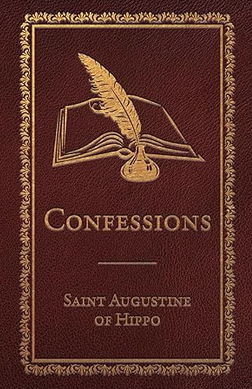
Fifteen years ago, I read The Confessions; I am not sure what prompted me to do so, other than perhaps a desire to read The Classics, and my belief that St. Augustine was like Cicero, a brother in avid pursuit of philosophy. My past self was not particularly impressed by the book, finding “Gloomy Gus’s” penchant for self-abasement depressing, and his particular focus on philosophy far too academic for my tastes. Then as now, when I read philosophy it is with an eye toward practical living – which why I like the Stoics. I was amused to learn later on that the translation I read, by Mr. Pine-Coffin, is “aptly named, for it is a dead translation”. When I decided to re-read The Confessions, now fourteen years a Christian in a very liturgical tradition, I chose to read Anthony Esolen’s translation. Not only do I enjoy Esolen as a writer and speaker in general, but it was his translations that took me through Hell,Purgatory, and finally Paradise. On having finished this a second time, I found it somewhat more enjoyable than my first go-round, especially once I realized that Augustine’s work was not merely woolgathering, but one volley fired in a battle of ideas — in this case, Christianity vs Manicheanism.
Confessions is frequently hailed as the first autobiography, but this is not an attempt by Augustine to give himself the Plutarch treatment. It is a spiritual biography, and Augustine’s growth as a man — from a selfish boy to a selfish youth to a young adult caught between the agonies of desire and the thirst for meaning — develops in tandem with his growth as a spiritual being. I noticed immediately there were elements from my original reading that I found far more compelling this round: when Augustine agonizes over stealing a fruit as a child, he is not being a self-flagellating puritan. However scrupulous he might have been, the moment is more than beating himself up: it’s a questioning of why we delight in transgressive behavior. He stole the fruit not because he was hungry or because he didn’t have the means to buy food, or even to spite the fruit-owner: he did it for the thrill of the steal. The older I get the more aware I am of that transgression for transgression’s sake and how pervasive it is in modern western society — from alt-right personalities embracing Hitler to activists defacing art with slogans. It strikes me, candidly, as Satanic — the spiteful decision to attack the good in creation in an attempt to frustrate the Creator.
The early sections can be compelling or boring depending on the topic at hand: Augustine’s greatest temptation appears to have been sexual appetite, not surprising for a young man, and his earnestness was such that he sent his mistress of many years packing away to Africa…only to relapse and find himself sleeping with both a new girl and his self-loathing. I could hear him echoing Paul — “the good I would do, I do not; and the evil which I would not do, I do.” These come along with discussions of Plotinus and neo-Platonic thought and there frankly my eyes would glaze over. These are not merely academic, though: just as Stoic praxis is grounded in Stoic cosmology, so too was Augustine’s perception of sin guided by his philosophical background. Critically, he regarded sin as originating not from inherently corrupt flesh, as the Manicheans and Gnostics did, but from a disordered soul. A disordered soul could be mended, but not through sheer force of will, as Augustine found out with his libido: grace was also needed, and there we move from philosophy to theology. For Augustine, grace breaking through was especially salient when he heard a voice urging him to “Take! Read!”, and then opened his Bible to a verse that cut his heart to the quick and made it clear that it was time for him to make a decision.
It’s fascinating to read this and then my old review, because past-me was very hostile toward the bishop. Although I became obsessed with philosophy, religion, and meaning in the late 2000s, I suspect parts of Confessions touched on parts of my being that were very sensitive — specifically, the memory of constant fear and self-loathing of my Pentecostal youth. When Augustine expressed humility, I reacted from the memory of constant condemnation — of myself, of the world, for every petty thing. Twenty years removed from Pentecostalism now, I can read Augustine as he is, and not some distorted version of him. There were some parts of my original review that indicate how poorly I understood what I was reading. I condemned Augustine for endorsing the ‘hateful split’ between the world of the body and spirit simply because he writes honestly on his problems with the passions. In fact, Augustine defends the body by arguing that it is the spirit that is disordered; the body itself is what God declared it to be in the first chapters of Genesis: ‘very good’. Gnosticism, Manicheanism, and many iterations of Protestant thinking are guilty of my condemnation, but not Augustine. At this point I’m also far more theologically aligned with Augustine on certain points that I would maintain even on secular grounds — particularly the notion of being curved in on ourselves, and of that being a source of much of our own inner poverty and social disorder. Although this is theologically dense, I enjoyed Augustine’s prayerful reflection on his life for the most part. It’s not a devotional text per se, but chronicles an important era of late-classical era thinking, and despite its age still speaks — though not necessarily on topics moderns dwell on today outside of college philosophy classes. This is a dense read — both of my priests looked askance at me when I said I was reading it — and some parts are just as opaque to me as they were in 2011. Now, though, I appreciate Augustine’s spirit more.
A note on the translation: Esolen as ever has expository footnotes, the text reads very cleanly, and some of the phrases chosen (“made myself a kingdom of want”) will echo in my head long after I’ve put this book back on the shelf. Given that all translation is interpretation, I have to wonder how much of my appreciation of this owed to Esolen’s translation. Who can read “Drunkenness is far from me; you will have mercy on me, so that it may never draw near. But feasting, well, that has sometimes crept up on your servant.” and not laugh?
Quotations
“[…]for you have made us for yourself, and our heart is restless until it rests in you.”
The house of my soul is too cramped for you to enter: make it more spacious. It is falling to ruin; repair it. Much inside it offends your sight; I know it and I confess it.
But I, I slipped away in the days of my youth, and wandered from you, my God, far afield from your steadfastness. And I made of my own self a kingdom of want.
Begone from my soul, then, those who say to it, “It all depends on what you take joy in. That beggar took joy in being drunk, but you, in glory.” What glory, O Lord? As his was no true joy, so mine was no true glory. No, it turned my mind to consider things more closely. That night, he would digest his drunkenness, but I had fallen asleep with mine and had risen in the morning with it, as I was going to do again—and look how many days!
For he wanted nuptials with death, and he who loves peril shall fall into it.
Drunkenness is far from me; you will have mercy on me, so that it may never draw near. But feasting, well, that has sometimes crept up on your servant.
WHAT have you finished reading recently? The Confessions, St. Augustine.
WHAT are you reading now? 2/3rds through Augustine: A Very Short Introduction, by Henry Chadwick. Also starting a re-read of The KunstlerCast: Conversations with James Howard Kunstler about the Tragic Comedy of Suburban Sprawl. I began it more or less because my reading had become becalmed, and I thought it would be interesting to revisit this after 15 years.
WHAT are you reading next? Science, baseball, who knows?



 Reading Freely